A launch is coming.
Spot missing product details and approvals before they hold up the launch.
We build custom internal software and connect the tools your consumer brand already uses. So product updates, approvals, and handoffs move forward with less copying and chasing.


10 years in agency + brand operations
12 years in software engineering
Move the information to whoever needs it next.
A supplier changes a cost. An approval stalls. A launch date moves. Someone still has to check what changed, chase a decision, and update every other system.
Miss a handoff, and the wrong product details can reach a partner, creative may need rework, or a launch can slip.
Check a workflow →
6 questions. No email needed.
Map how work changes hands →
Build your workflow map and download a first fix.

Illustrative workflow: a supplier cost change.
Match the supplier update to the right product and compare the new cost.
Send the change to its approvers. Hold release until the required decisions are complete.
Update the agreed systems and confirm the change arrived. Keep a record of the result.
Missing information or a failed update? Flag it for the responsible person, keep it open, and confirm it is resolved.
Explore two example workflows, from the first change to the final approval. These demos use fictional data.
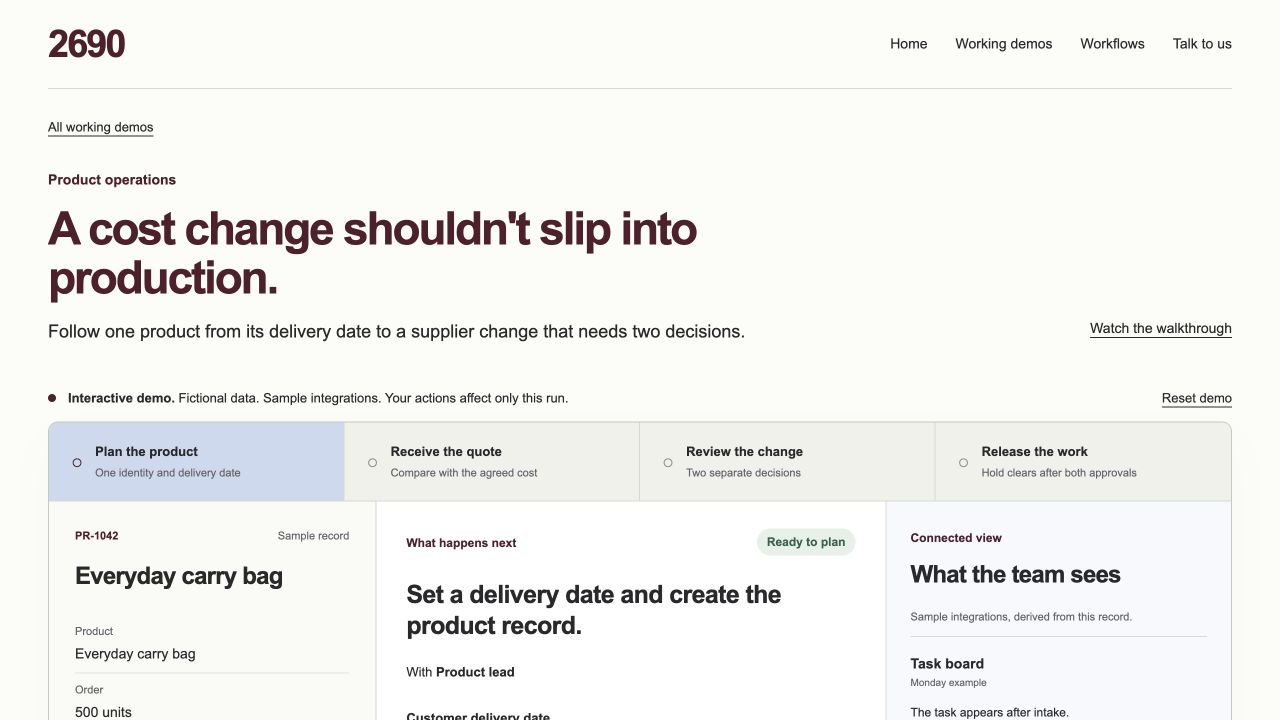
Product operations · fictional demo data
Catch incorrect costs before release and spend less time chasing sign-off. In this demo, a supplier change stays on hold until both required approvals are complete.
Try the product demoSpend less time checking what went live. Flag differences from the approved creative so your team can correct the ad sooner.
Looking for another starting point? Browse 77 workflow ideas.
More time for launches, customers, and decisions. Less time keeping systems up to date. Choose the improvements that matter to your team:
Spend less of the week copying information, checking statuses, and chasing approvals.
Measure it: hours spent each week.
Reduce repeat handling and rework. See whether the same job takes fewer paid hours to complete.
Measure it: labor and operating cost per task.
Flag missing details, mismatched records, and unapproved changes before the next team acts on them.
Measure it: error rate and time spent correcting work.
Give each handoff an owner and a clear next step, so work spends less time waiting.
Measure it: time from request to completion.
Take on more products, partners, or launches without increasing manual coordination at the same rate.
Measure it: completed work per person, with quality checks.
Illustrative estimate · not a customer result
If a workflow frees up 10 hours a week, your team could put that time toward launch planning, supplier decisions, or customer work.
10 hours/week × $50/hour × 52 weeks
$26,000annual team capacity value
A $10,000 build would equal about 20 weeks of that capacity value, before ongoing software and support costs.
Bring one recurring task. Together, we work out:
No finished ROI spreadsheet needed.
Turn a recurring manual process into software your team can rely on.
From $10,000
Small sprints from 3 weeks.
Larger builds planned for 5-6 weeks; broader systems delivered in phases.
Schedule depends on scope, system access, and timely feedback.
What shapes the scope?Start with a free conversation. Talk through the workflow with Matt before deciding whether a build makes sense.
Agreed checks before final payment. You know how we’ll verify the delivered work.
Start with a call with Matt. You’ll review the scope, price, and delivery checks with Matt and Mike before committing.
We map the process, agree the rules and scope, and record a baseline where the impact can be measured.
We connect the systems, build the software, and define what people and AI can access or change.
We test permissions, approvals, and failure handling against the agreed scope. You approve the release.
We train your team, document ownership and support, and review the agreed measures.
Matt brings the brand and agency perspective. Mike brings experience building and operating production software.
Co-founder · Agency + brand operations
10 yearsagency, brand, and SaaS growth & ops experience.
Co-founder · Software engineering
12 yearsbuilding production software at a Fortune 500 company.
Why 2690? It’s the house number where we grew up building LEGO and playing video games. Now we build software together for your brand.
No. Bring the problem or outcome you have in mind. We ask the follow-up questions and agree the scope with you.
Not necessarily. We use your existing tools where they fit. If you need a shared database, you’ll know why and what it costs before we build.
Sometimes. We check your existing tools first, connect what works, and recommend custom software for the remaining gaps.
No. We use AI where it has a useful role, with checks and human approvals appropriate to the job.
Yes, where our experience fits. Consumer brands are our main focus; agencies can also bring us into client projects.
Your proposal defines the included support. You can add an ongoing support and development plan, with Matt as your point of contact.
Bring an example to a call. We’ll help you choose a starting point.
Let’s talk about your projectMay we use Google Analytics to understand visits and improve this site? Analytics cookies are optional. Privacy details